Showing posts with label design cosmology. Show all posts

Friday, April 29, 2011

unit summary 3

rem koolhaas' casa de musica and le corbusier's ronchamp
images from oma.eu and wikipedia.com

By 1900 CE, systematic colonial expansion had disempowered entire nations throughout the southern hemisphere and brought extreme wealth to a few select European countries.  England became the undisputed world power and the Victorian era saw the emergence of many new urban building types such as railway stations, museums and government buildings, which were composed from a mix of historical styles later known as eclecticism.  In reaction to England’s urban expansion and industrialization, a group of artists and designers led by William Morris worked against what they called the dehumanization of industrial life and created the Arts and Crafts movement, which explored hand-crafted, “authentic” design that continues to influence residential design both in Europe and abroad.  

Philosophers and scientists such as Karl Marx and Charles Darwin were challenging conventions, shedding light on the inner workings of capitalism and natural selection while urban planners like Ebenezer Howard called for the design of smaller cities based on a more human scale.  In Napoleon’s France, Paris was completely rebuilt with wide boulevards, bourgeois apartments and monumentally placed buildings, which inspired the City Beautiful movement in the U.S.  

By the turn of the 20th century, an architectural exploration of organic form and rich materials known as Art Nouveau flourished in Spain and Belgium primarily through the work of Antoni Gaudi and Victor Horta, who developed a modern style that embraced both the industrial and natural world.  This balance, along with the spatial innovations of Frank Lloyd Wright and new materials such as steel and concrete set the scene for the Expressionist movement, which later informed the Bauhaus in Germany, De Stijl in Holland and the Constructivists in the Soviet Union.  It was at this point in time, that Le Corbusier, Ludwig Mies van der Rohe and Walter Gropius began to make their mark on modernism through books (Corbusier’s vers une architecture) exhibitions (Mies’ Barcelona International exhibit) and education (Gropius’ new school for design The Bauhaus).  Like so many other great thinkers and designers, Mies and Gropius fled Europe during World War II and found positions teaching in the U.S. where they greatly influenced American architecture. 

By the mid 1900s, large American architecture firms were established, first with McKim, Mead and White (who designed Pennsylvania Station) and later with Skidmore Owings and Merrill (responsible for the Seagram Building).  By the 1960s, other experimental architecture movements were challenging the conventions of modernism and its anti-contextual aesthetic.  These new movements included Brutalism marked by large scales and simple forms, Archigram influenced by Pop Art/youth culture, and Postmodernism, which expressed irony and parody through exaggerated forms and a heightened awareness of context.  At the end of the 20th century, avant-garde architecture embraced computer aided design and new technologies to create dynamic buildings such as Frank Gehry’s Guggenheim Museum, and Peter Cook and Colin Fournier’s Kunsthaus. 

Today, BIM technology, increased globalization, environmental sustainability, relief/aid, preservation, and “starchitects” are all influencing architecture, which is re-inventing itself at an ever-increasing rate.  As the cost of petroleum rises along with the amount of people living in city slums (this figure is estimated to be 1 in 3 by 2020), notions of commodity, firmness and delight and good design for all seem more relevant than ever.  

blog post 14: design influences

Saturday, April 23, 2011

reading response 12: corbu+bouroullec

last summer i visited a bouroullec design exhibit in apartment 50 of corbusier's well known unite d'habitation complex located in la cite radieuse of marseille, france.  this was an incredible opportunity to experience a corbusier apartment first hand-- and witness how people currently live in his buildings.  i was happy to see that unite d'habitation is still a very vibrant and diverse place where immigrants, students, teachers and design enthusiasts live side by side.  

Friday, April 8, 2011

unit summary 2


Having established architecture’s foundations, the world’s cultures entered an era of architectural reverberation—an exploration marked by reflection, repercussion and repetition.  During this time, architectural movements in the west refused and reinterpreted the foundations while movements in the east echoed the past.

 400 CE saw the decline of Europe as power shifted from the Roman Empire to Western Asia and Byzantium.  Religion became a key factor, transforming the cultural and physical landscape of the globe as Buddhism and Hinduism swept across Asia and Christianity took hold in Europe.  Architectural expressions of faith gained prominence as colossal rock-cut Buddha figures, Hindu temples and Christian churches evolved around the notion of organized religion.   In the east, introspection and enlightenment were found at sites such as the rock cut Ajanta Caves in India and the Angkor temples in Cambodia, where elaborate carvings encourage the eyes to dance across detailed surfaces.  To the west, buildings of worship such as the Baptistery
At Ravenna and St. Peter’s in Italy utilized the dome and transept as large-scale worship became common.

In 600 CE, South American civilizations thrived as Mayan city-states competed for dominance and developed the most advanced calendar in the
world.  In Eurasia, the Byzantine Empire dominated the Mediterranean and developed new architectural forms such as the brick dome, having forgotten the concrete construction methods of the past.  The magnificent Hagia Sophia in Constantinople was constructed during this time and still stands as a shining example of the wealth and ambition of Byzantium.  Meanwhile, Muhammed established Islam in the Middle East where the fine masonry craftsmanship of Greek and Hellenistic architecture was preserved.  In Asia, a new building form known as the pagoda emerged as Buddhism slowly moved out of India and into Korea and Japan.

800 CE marked the rise of China’s T’ang dynasty located at the end of the Silk Trade Route, the new Islamic Kingdom, which stretched from Persia to Spain, the Khmer Kingdom of Cambodia and a new generation of Mayan city-states in Central America.  Significant religious buildings such as the hypostyle hall, Dome of the Rock and the Borobudur stupa shrine were built during this time of rigorous religious and intellectual activity.

The turn of the millennium saw the decline of the Silk Trade Route due to upheaval in Northern China, which consequently led to the economic rise of Southeast Asia where alternate trade routes were built alongside thousands of new temples.  In the Islamic world, the two political entities known as the Sunni and Shi’ite were taking form while great mosque and palace builders further developed an Islamic building aesthetic, which was integrated into the continental style to create the base for Gothic architecture in Europe.  This blending of cultural styles is indicative of the global sensibilities that are beginning to manifest in architecture as a vision of the world is becoming clearer.  Buildings of note during this time include the Canterbury Cathedral, the Rajarani Temple, the Great Mosque of Isfahan and the Baptistery of Pisa.

1200 CE was an era of architectural patrons in Asia who valued the influence of buildings on society.  Substantial commissions across the continent resulted in new Hindu temples, Buddhist Pagodas and Palaces—all variations of the past, with replaceable parts that allowed for the upkeep and increased longevity of these sacred places.  In the Christian world, cathedrals (the Gloucester Cathedral), pilgrimage churches (Notre-Dame de Reims) and mendicant churches (the Dominican Church of Toulouse) made an impact on the landscape, leading eyes upwards with striking vertical elements.  Meanwhile, Mongolian invasions threatened growth in the Islamic world with the exception of Africa where the Trans-Saharan trade routes allowed for the construction of great earthen mosques like the Djenne mosque in Mali.

In 1400 CE, a new wave of urbanism swept across the globe where cities such as Seoul, The Forbidden City (Beijing), Mexico City and Cairo were transformed into the vibrant centers they are today.  Hundreds of thousands were killed worldwide by the Black Plaque, which held back Europe’s economic development until the middle of the 15th century.  In Latin America, the Incas dominated coastal trade routes, where they built roads and cities such as Machu Picchu, which were impressive examples of rubble masonry.  In the Mediterranean, the Venetian Republic dominated trade and brought wealth to Italy where magnificent buildings such as the Florence Cathedral, Medici Palaces and Ca’ D’oro can still be seen. 

1600 CE was all about relative political stability and efficient ocean trade, which moved wealth and ideas around the world at an amazing rate.  Great thinkers such as Michaelangelo and Leonardo da Vinci influenced European design from St. Peter’s Basilica to the Chateau de Chambord and ambitious buildings in Asia such as the Taj Mahal, and Dahai Lama’s Potala Palace added drama to the eastern aesthetic. 

1700 CE saw the effects of full scale European colonialism, which spawned new port cities across the globe and founded the system of the Fort and Plantation, where local and enslaved people were transformed into workforces.  This colonial activity inevitably resulted in an extreme amount of wealth and aristocratic privilege as a new high-bourgeois class led indulgent lives that included large-scale baroque architectural projects such as Versailles, the Hotel des Invalides and Place Vendome.  Europe’s economic disparity coupled with heightened religious persecutions and costly wars created a sense of unease across the continent that would eventually lead to revolution.  In Asia, The Quing Empire became the largest in Chinese history while in West and Central Asia, Islamic architecture went into decline as the region became an economically marginalized center.

In 1800 CE, the Enlightenment, conflicting colonial ambitions and the rise of the Industrial Revolution sparked a lot of radical change in the western world. New building types relating to industry and increased population developed in the form of factories, ports and prisons, while new government buildings were built including the new Houses of Parliament in London, the Virginia State Capitol, the US Capitol in Washington and the Somerset house in London.  Innovative building techniques and materials, particularly iron challenged architects to rethink architectural forms as neo-Greek, and neo-gothic movements romanticized the past.  

Wednesday, April 6, 2011

reading response 11: stepping it up


blog post 11: a modern scale

this post explores notions of modernity by taking one object and then telescoping outwards to view the space, building and place that ultimately interact with it.  Having just visited frank lloyd wright's falling water residence, i decided to focus on the japanese wood block print, which hangs on a wall in the largest bedroom.  

the block print is titled horikiri iris garden and was completed in 1857 by utagawa hiroshige, a prolific ukiyo-e landscape artist who was known for his unconventional cropping, composition and perspective.  hiroshige's work influenced post-impressionist artists such as vincent van gogh and was highly valued by architect frank lloyd wright, who integrated japanese principles such as asymmetry, horizontality and a connection to nature into his buildings.  

Wright collected japanese wood block prints and enjoyed hanging them in his spaces, which are in a sense, abstracted reflections of the ukiyo-e aesthetic.  looking at the collage above, it's clear that the print, bedroom, falling water residence and laurel highlands are all connected to create what wright called "organic architecture", which is centered around the belief that buildings should be part of their surrounds, rather than defy them.  This detailed, holistic approach to architecture and design is uniquely modern in that it strives for symbiosis and is informed by diverse perspectives.  

Monday, March 28, 2011

blog post 10: a revolution stitched together by women

image credits: mira eng-goetz, runninginheels.co.uk, lynnchapman.blogspot.com, inspiredphoenixinhk.files.wordpress.com
this week's blog post assignment challenged us find an everyday artifact that carries a message of revolution and then deconstruct the design language of that artifact to better understand its cultural meaning.  wandering around my house, i was surprised by the amount of objects i could associate with revolutions, whether they be sexual, political, intellectual, technological, financial or alimentary (tampons, passports, books, an i pod, a dollar bill, a salt shaker...).  in the end, i chose to focus on the little piece of embroidery that i've been carefully stitching for far too long now.  the embroidery is in the traditional sashiko style, which began in the farming and fishing villages of japan during the edo era (1615-1868) when all fibers were hand spun, woven and dyed in a labor intensive process.  

sashiko was a quiet revolution born out of necessity and developed by the ingenuity of women who recycled old clothes in order to endure the cold winters and physical labor of rural japanese life.  in the face of a hard existence, women managed to create beautiful and unique clothing with what little they had to express a pride for their lifestyle and history.  

the images above illustrate the geometric patterns and indigo dyes used to create quilted work garments of cotton or hemp.  the consistent use of blue and white in sashiko textiles is evidence of a socially imposed "uniform" designated for laborers who were restricted from wearing bright colors or refined fibers such as silk.  a simple running stitch of white cotton thread binds layers of fabric to increase the warmth of the garment and convey family heritage through regional patterns often depicting elements of nature.  the photo above depicts japanese women collecting cedar trunks from the steep mountain just outside their village.  their sashiko work jackets are reinforced along the shoulder line where the heavy timbers rest as they climb down the mountain.  


Monday, March 21, 2011

reading response 9: colonial shadows in a senegalese city

photo credits: mira eng-goetz and wikipedia
this week in class, we've been exploring the affects of colonization on architecture around the world. throughout europe during the 1600s, an increase in wealth, food security and ship design led merchants to establish far reaching sea trade routes that inevitably included west africa.  the main port on africa's atlantic coast was established by the french in 1659 on a narrow island just off the coast of senegal called ndar locally, and named saint louis du fort by the colonizers in homage to their king louis XIV.  as a permanent french settlement, st. louis became the leading urban center in sub-saharan africa, exporting gum arabic, beeswax, hides and most importantly--slaves.  

between 1659 and 1779, a bourgeois franco-african merchant community known as the metis played an important role in the political, cultural, social, and economic life of the city.  catholic institutions, refined entertainment venues and elegant boulevards lined with white washed stucco buildings in the french colonial style were funded by the metis.  although  the old city of st. louis still stands with its shuttered windows, wrought iron balconies and baguette carts, it's become rather tattered around the edges with signs of disrepair and neglect.  today senegal's capital dakar is the country's leading economic port and consequently st. louis' trade economy has been overshadowed.  nostalgic french tourists keep the old quarter afloat with their patronage of the bars, hotels and craft stands.  

i have visited st. louis a handful of times, and have come to realize that the true life of the city now exists outside of the old quarter-- beyond the colonial architecture and into the colorful sections of the city that are unmistakably senegalese.  colorful painted pirogues (canoes), road side cheb-u-djen (rice and fish) restaurants, mosque minarets, the scent of drying fish and sugary mint tea all bring me joy to know a people that has risen out of slavery and colonization to maintain their own culture in the end.

blog post 9: greek ideals, colonial victories

image credits: buysbshoes.com, nikeblog.com, selmaala.blogspot.com, teamsweat.org, thehistoryblog.com
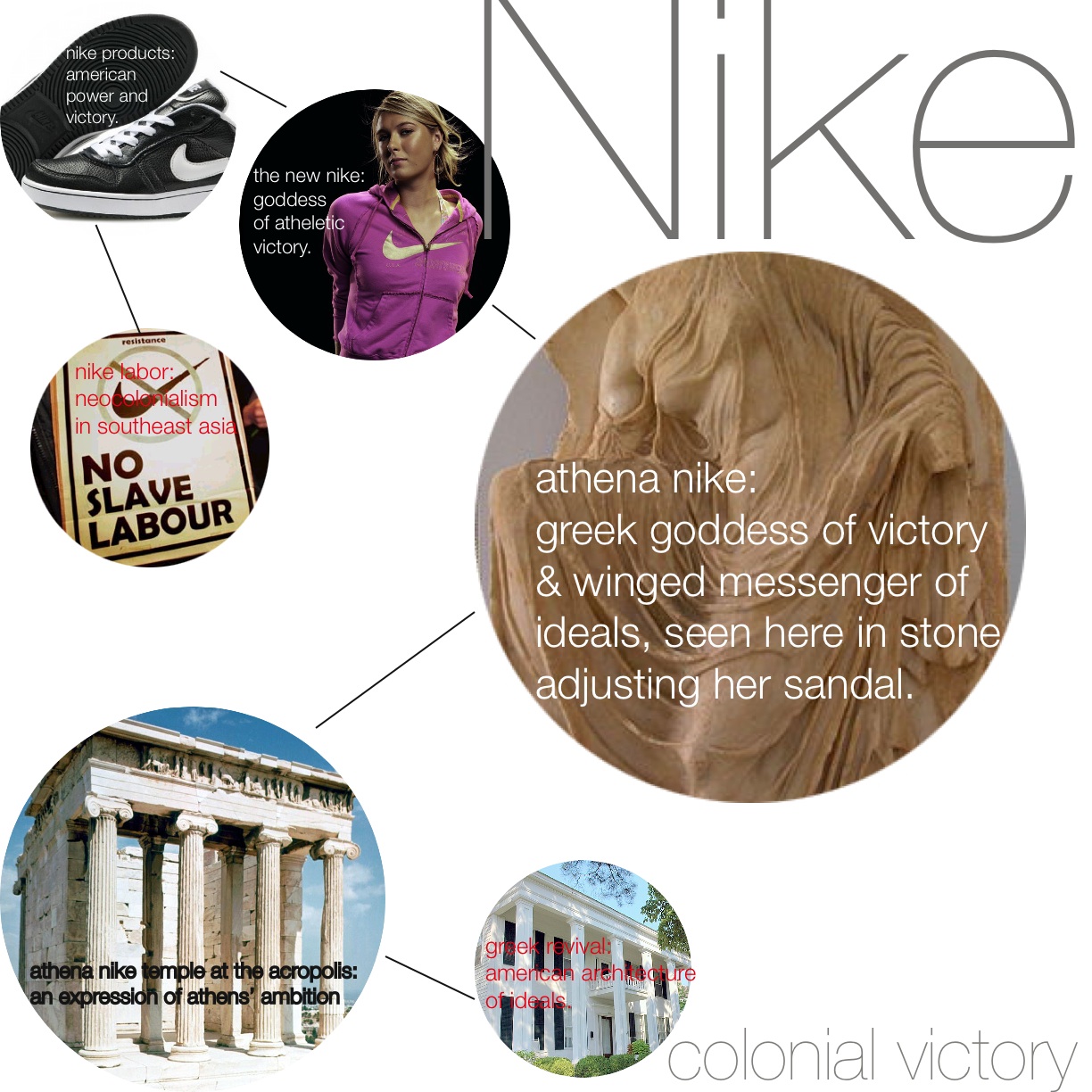
this diagram illustrates the influence of greek ideals on colonial trends to and from the united states.  at the heart of the diagram you'll find athena nike (seen in a relief carving from the parapet of the athena nike temple at the acropolis).  these days, mention nike to most anyone around the globe and visions of air jordan or the "just do it" swoosh will likely come to mind before the goddess.  but the ideal still stands: victory... at any cost.  and in the case of the nike corporation, many have judged the poor working conditions and human rights violations characteristic of nike's overseas factories to be nothing short of neocolonialism: capitalist victory at any cost.  

working back, a glance at the athena nike temple will elicit a sense of deja vu for most americans who have experienced the greek revival architectural style that has held sway in our landscape since the beginning of our colonial history.  the columns, symmetry, portico, and entablature... it all translates to strength and harmony.  in the case of the athena nike temple itself, the architecture lets us know about the powerful ambition of athens.  doesn't it seem appropriate then, that a country with loads of power and ambition would choose to model it's homes after such an archetype?  

reading response 8: the understated beauty of ukrainian baroque


photo credits: mira eng-goetz and kraevid.org
this little book, which i made in the style of a "visitor's kit" was inspired by my visit to the saint sophia cathedral in ukraine back in 1995.  at the time, i didn't speak a lick of ukrainian and there were no pamphlets or descriptive posters in english to clue me into the history of this amazing building.  so years later, i've decided to make my own little guide... in english!  it seemed appropriate considering our focus on european cathedral design and baroque aesthetics in class this week.  saint sophia's cathedral has a byzantine interior and a ukrainian baroque exterior that complement each other well.  as you flip through the tiny pages, these architectural features are explained along with the building's tumultuous past. as an added bonus, the kit includes a bit of incense and gold leaf to help bring this unique cathedral home to you.

Monday, March 7, 2011

blog post 8: a spiral of architectural progression

the nautilus has long been a symbol of nature's mathematic perfection-- the logarithmic spiral, which illustrates a unique geometric progression.  but what other progressions could this nautilus symbolize?  the progression in size of a living creature?  the progression of time it took a mollusk to create new chambers within its shell?    

in thinking about the various progressions found within a nautilus, we are reminded that within this delicate shell lies a record--evidence of evolution.  it's in this spirit that i have used the spiraled fibonacci sequence to outline the progression of architecture's evolutionary use of nature's mathematic forms, proportions and symmetry.   


"... because nature, in what it makes, records how it is made.  in the rock is the record of the rock, and in man is the record of man.  man, through his consciousness, senses inside of him all the laws of nature... that which is the nature of man, he inherits, just like his physical being, in this he senses the desire to learn to express."     -louis kahn


"without symmetry and proportion there can be no principles in the design of any temple; that is, if there is no precise relation between its members as in the case of those of a well shaped man."     -vitruvius


photo credits: themudflats.net, solarnavigator.net, ifdawn.com, antiquesdiva.com
beginning with interior point of the spiral, this diagram illustrates:
the yen and yang symbol, the pi symbol, the kofu pyramid at giza, the vitruvian man,  le corbusier's modulor, palladio's villa rotunda, le corbusier's villa savoye and a golden mean diagram of the villa savoy's elevation.

Sunday, February 20, 2011

blog post 6

image credit: chestofbooks.com, corbisimages.com, faculty.de.gcsu.edu, popartmachine.com, redbubble.net, visitsomme.com, arthistory.upenn.edu, de.academic.ru
medieval mental map

Wednesday, February 16, 2011

unit summary 1

F O U N D A T I O N S :  A   S U M M A R Y

photo by Mira Eng-Goetz

The foundations of architecture lie in a complex, global narrative that is constantly evolving as new archaeological sites are discovered and perspectives change. Across the globe, we’ve studied examples of early cultures developing their own architectural foundations through a process of prototypes, hybrids and archetypes.

Beginning in 3500 BCE, a shift towards agricultural production led the emergence of extensive shore and river oriented cultures in the Americas, Europe, Africa and Asia. During this period, granaries, tombs, temples and shelters were established as caves, temporary wood aedicules and stone structures. In the British Isles, large circular arrangements of monoliths are still standing as evidence of early agrarian societies, attuned to the movements of the moon and stars.

Astronomy based architecture is further developed with structures such as Stonehenge in England, and Zoser’s temple complex in Egypt. These iconic sites represent not only incredible engineering and organization, but an effort to understand the universe and humanity’s place within it. Structures in stone were meant to last, and witnessing these monuments, one can’t help from wondering if their purpose was to convey a message into an unknown future. Is it a coincidence that the circular structures of the era relate in form to the moon and stars they pertain to? Could it be that the stacked layers of a tapered pyramid are intended to point upwards to the heavens like great mountains? Can we deny the relationship between a colonnade and a grove of trees?

Massive pyramids and monoliths aside, other feats of engineering included sophisticated city planning, irrigation canals, terraced grain fields and advanced metalworking skills, which mark the Bronze and Iron Ages from 2500-1200 BCE. This was a period defined by flux and movement. Drought and climate change brought turmoil and decline, invaders overturned cities, the writing of sacred texts gave a new role to religion, and the use of caravans increased trade. Key sites of the era include the Temple of Luxor in Egypt, the city of Mycenae in Greece and the Bird Mound at Poverty Point in the US.

Between 1000 and 400 BCE, iron rich cultures armed with metal weapons dominated and flourished, drastically changing the world’s power structure. It was in this age of weaponry, that we find the Nubians in Egypt, the Ionians in Turkey, the Etruscans in Northern Italy and the Dorians in Greece where economic power and cultural continuity led to new explorations in early Greek stone architecture. In West Asia, the Babylonian empire collapsed resulting in a power shift towards Persia and in China, the long lasting Zhou dynasty established urban planning principals that are still utilized today. Trade is was important as ever, and agricultural developments such as corn, resulted in economic and architectural growth in Central America where the first Olmec ritual centers developed. During this period, many of the architectural elements we have become familiar with were taking form: The Etruscan keystone, the temple of Poseidon oriented on the Cardo and Decumanus, the arched Ishtar Gate of Babylon, and the Temple of Apollo at Thermos—a rectangular, columned prototype for future temple design.

Around 600 BCE, Western and Central Asia were part of the Persian Empire, with capitals at Persepolis and Pasargadae. In The Americas, the Maya, Zapotec and Mound Building peoples emerged and the Mediterranean was under Greek control. The notion that man could serve god fundamentally changed the religious, social and ethical role of human existence. Buddhism, Daoism, Confucianism, Zoroastrianism and Hellenism led to unprecedented expressions of faith in architecture. In the Greek Empire, continuity of architectural form and diverse surface design defined an architectural style that was both Greek and regional. Monumental buildings such as the Temple of Segesta and the Parthenon tell us something about the Hellenistic dilemma of ideal vs. real and the ways in which forms can be manipulated to attain perceived perfection. The Doric, Ionic, and Corinthian columns of Greece are beautiful examples of the design process and remind us of the ever evolving quest for modernity, while early examples of rock cut architecture at the Barabar Hills in India are perfect interpretations of Buddhism as an inner journey.

From 0-300 BCE, The Silk Trade and sea routes were established as the Kushan, Partheon and Han Empires held ground across Asia and the Roman Empire flourished into a vast civilization marked by an extensive urban architecture never before seen. Across the Roman Empire, cities were oriented on the cardinal directions in a grid system. This idea of order and consistency was both a social and defensive strategy—putting people in their places and orienting the world according to an axis where two major paths create divisions around a focal point (on par with how Rome perceived itself in relation to the rest of the world). Rome’s impressive architectural repertoire included: extensive roads, arched aqueducts, public bath houses, temples, free standing arches, pillars, markets, forums, amphitheatres, colosseums and domes—all used as signs to mark the landscape and with the Roman ideal. The Pantheon, continues to bring the Roman ideal to visitors who come from around the globe to witness the UTILITY, FIRMNESS AND DELIGHT that this monument provides. Looking up at the oculus at the center of the domed ceiling, we feel an implied vertical axis reaching up into the heavens and down into the earth where the sacred resides. To the east, the circular Sanchi Stupas in India share this implied vertical axis, which creates a sacred spot around which worshipers circumambulate. This combination of the circle and crosshairs brings harmony to architecture around the world and speaks to a universal language of form and balance that lies at the heart of architecture’s foundations. Other key sites of this era include The Pont du Gard in France, The Great Wall of China, the rock Nabataean sites at Petra in Jordan, the Mingtang Byong Ritual Complex in China and the Guachimonton Complex in Mexico.

Monday, February 14, 2011

reading response 5

this reading response addresses examples of early hellenistic, buddhist and christian architecture.  9 blocks are color coded according to religion, each illustrating a specific religious site and its characteristics.  on the cover and case of this response, i have chosen to use a few words to express the diversity of architectural religious expression: 
SOLITARY + INTIMATE + COMMUNAL : ARCHITECTURE + WORSHIP + RITUAL + FAITH
these words are intended to engage us in thinking about the ways we choose to worship and how ritual shapes architecture/how architecture shapes ritual.  in the case of buddhism, the ritual is inward and relies on personal reflection and solitude, which is achieved through rock carved architecture, circumambulation and a very personal space.  this stands in high contrast to the hellenistic rituals of the greek empire, where buildings such as the parthenon were erected as homes to the gods-- an extended family, worshipped in an intimate setting illustrated with ritual sacrifice.  and then we come to the expansion of christianity where once out of the catacombs,  ritual became a large scale, communal event-- a passage to salvation and imperial glory best experienced in large churches based on the layout of a basilica.  


Friday, February 11, 2011

Sunday, February 6, 2011